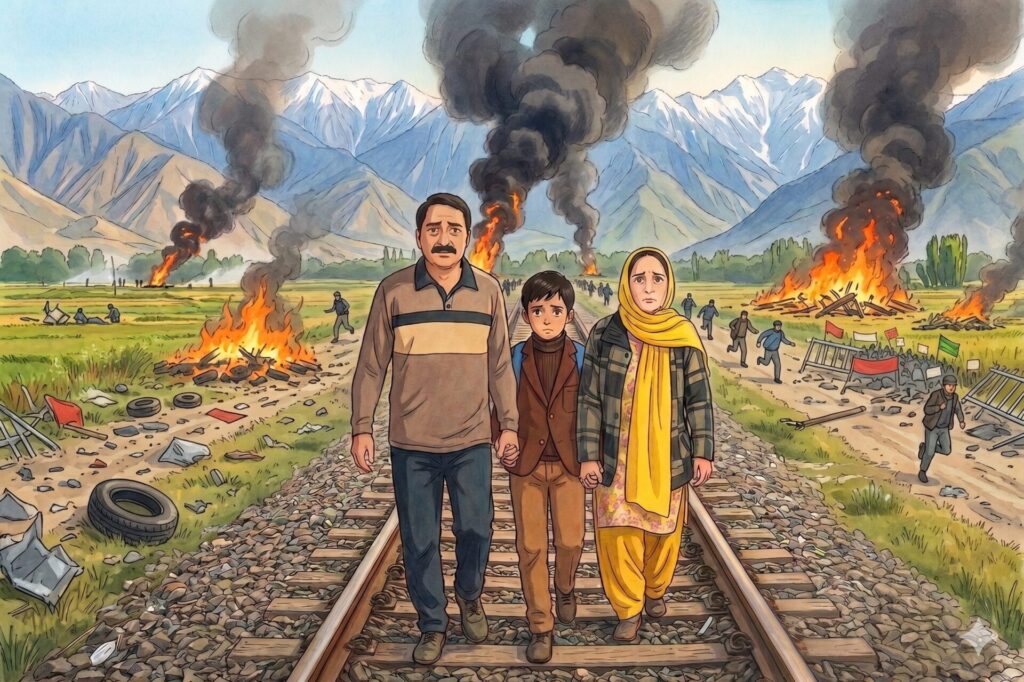
16 kilometers under gunfire
I was ten years old.
It was 2010. Kashmir had been shut for weeks. Strict curfew, no transport, no internet. Even the cellular services were curtailed. The kind of chaos the adults around me were scared of and could not explain.
I had an exam.
Every other school in the valley was closed. Mine wasn’t, because it was a central government school inside a military compound — different rules, a national schedule, exams that had to happen. So my parents and I decided we would walk.
My school was eight kilometers one way.
We left early in the morning, when things were quieter. We took the direct route. We made it to school.
It was the walk back I remember.
We were getting ready to leave when someone told us four people had been killed in the town one kilometer from the school. We could not take the direct route home.
So we took the railway track. Two or three kilometers longer. We thought it would be safer because trains weren’t running.
The tracks were not empty. There were people running on them. The protests were happening meters from us — violent, chaotic, loud. There was gunfire. Bullets going over our heads, close enough to hear properly. My father on one side of me, my mother on the other. We just kept moving.
We made it home.
That is the entire story. There is nothing more to it. A ten-year-old, his parents, sixteen kilometers, and a road that should not have had a child on it.
I’m 26 now. I live in Germany, 8,000 kilometers from that road. I co-founded a startup. I am a Lead Engineer at one of the best WordPress agencies in the world. I won the Digital India Award when I was 15, graduated with a gold medal, wrote ten research papers before realizing I didn’t actually like writing them.
On paper, I had survived and succeeded. Yet, a few weeks ago, I felt like a failure.
I scrolled through people my age earning many times what I earn. I looked at founders whose companies were further along than ours. I sat at my desk and felt like I had nothing to show for the last sixteen years.
I felt so bad I could not work for weeks. I did not even touch my laptop.
Then a relative posted some old photos. Digital India Award. Gold medal. A few other moments from the last decade. And a video of our startup being featured on local Saarland TV.
I sat with that for a while. Not because the moments were impressive.
Because I had forgotten I was the same person in all of them.
And then I remembered the walk.
This is the part of the post where I am supposed to give you a system. A morning routine. A productivity framework. The five things I do every day to stay focused.
I don’t have any of that.
I don’t wake up at 4 a.m. I don’t do cold showers, I don’t journal. I procrastinate. I live on fast food when I am too tired to eat. I have days where I cannot produce a single useful thing. I wake up when I wake up.
I am not a person who has figured it out. I am a person who keeps going, with sheer resilience and grit.
And the reason I keep going is not discipline. It is a reference point.
When the road in front of me looks dark — when the work is hard, when the comparison is brutal, when the part of me that wants to quit is louder than the part that doesn’t — I go back, in my head, to a railway track. A ten-year-old between his parents. People running. Gunfire meters away.
A bad week is not that. A burnt-out month is not that. A LinkedIn post about someone earning ten times my salary is, very obviously, not that.
I have already done the scariest thing I will ever do. Everything since has been, in the most literal sense, easier.
That is why no challenge scares me. Not because I am brave. Not because I am disciplined. Because I have a reference point that does not lie to me.
I was ten. I just walked.
We all have a hardest thing we have ever done. What is your reference point?
Leave a Reply